Dental Implants in Eatontown: Timeline, Cost and What to Expect

What a single implant costs here, why treatment runs three to six months, what a bone graft adds, and who does the surgery. Written for people weighing their options in Monmouth County.
A single dental implant at our Eatontown office generally runs $3,500 to $6,000 from the surgical post through the final crown. Treatment usually takes three to six months, because the implant has to fuse with the jawbone before the tooth goes on top. If you need a bone graft first, add three to six months to that.
Those are the two questions almost everyone asks first, so we put them at the top. What follows is the rest of it: who does each step, what the appointments actually feel like, when a different treatment makes more sense, and how people in Monmouth County pay for this.
If you want to talk it through with a person instead of reading, call (732) 542-7770. We're at 286 Highway 35 in Eatontown, open Monday through Thursday.
What do dental implants cost in Eatontown?
Our range for a single implant is $3,500 to $6,000. That spread is not vague pricing. It reflects real differences between cases: whether the site needs grafting, which type of crown goes on top, whether a tooth has to come out first, and how much imaging the case needs.
A full arch costs considerably more, because you're paying for several implants plus the bridge they carry. We quote those case by case after a scan, and we put the whole thing in writing before anything starts.
What the estimate should always break out separately: the extraction if you need one, any bone graft, the implant post, the abutment that connects post to crown, and the crown itself. If you're comparing us against another office, compare those five lines. A number that sounds lower often covers fewer of them.
Dental insurance treats implants differently from plan to plan. Some cover a share of the crown but not the surgical placement. Bring your plan details to the consultation and we'll tell you what we can estimate and what only your insurer can confirm.
How long does the whole process take?
Three to six months is typical for a straightforward single implant. Here's where the time actually goes.
Visit one, the consultation and scan. We take a 3D scan to see bone height, bone width and where the nerve sits. This visit is where you find out whether you're a candidate and what the real sequence looks like for your mouth. Roughly an hour.
Visit two, placement. The implant post goes into the jaw. Most patients are surprised by how ordinary this appointment is. It's usually shorter than a root canal and done with local anesthetic, though sedation is available if you want it.
Then you wait. This is the long part, and it isn't optional. The bone grows around the titanium post and locks it in place. That process, osseointegration, generally takes three to four months. You're not walking around with a gap the whole time in most cases; we can discuss a temporary.
Visit three, the abutment and impression. Once the post is solid, we attach the connector and take impressions for the crown.
Visit four, the crown goes on. We check the fit, the bite and the look, then seat it. That's the finish line.
Do you need a bone graft first?
Maybe, and the scan is what tells us. When a tooth has been missing for a while, the bone that used to hold it shrinks. An implant needs enough bone to anchor into, so if there isn't enough, we build it up first.
A graft adds three to six months before placement can happen. It also adds cost. Nobody enjoys hearing this, but finding out on the scan is far better than finding out during surgery.
The flip side is worth knowing: if your tooth is still in place but failing, you may be able to skip the graft entirely. Bone starts shrinking after the extraction, not before. Patients who come in while the tooth is still there often have simpler, cheaper treatment than patients who waited two years. If you're putting off an extraction you know is coming, that's the one argument for getting it looked at sooner.
You can read more about the procedure itself on our bone grafting page.
One tooth, several teeth, or a full arch
These are genuinely different treatments and the costs aren't proportional.
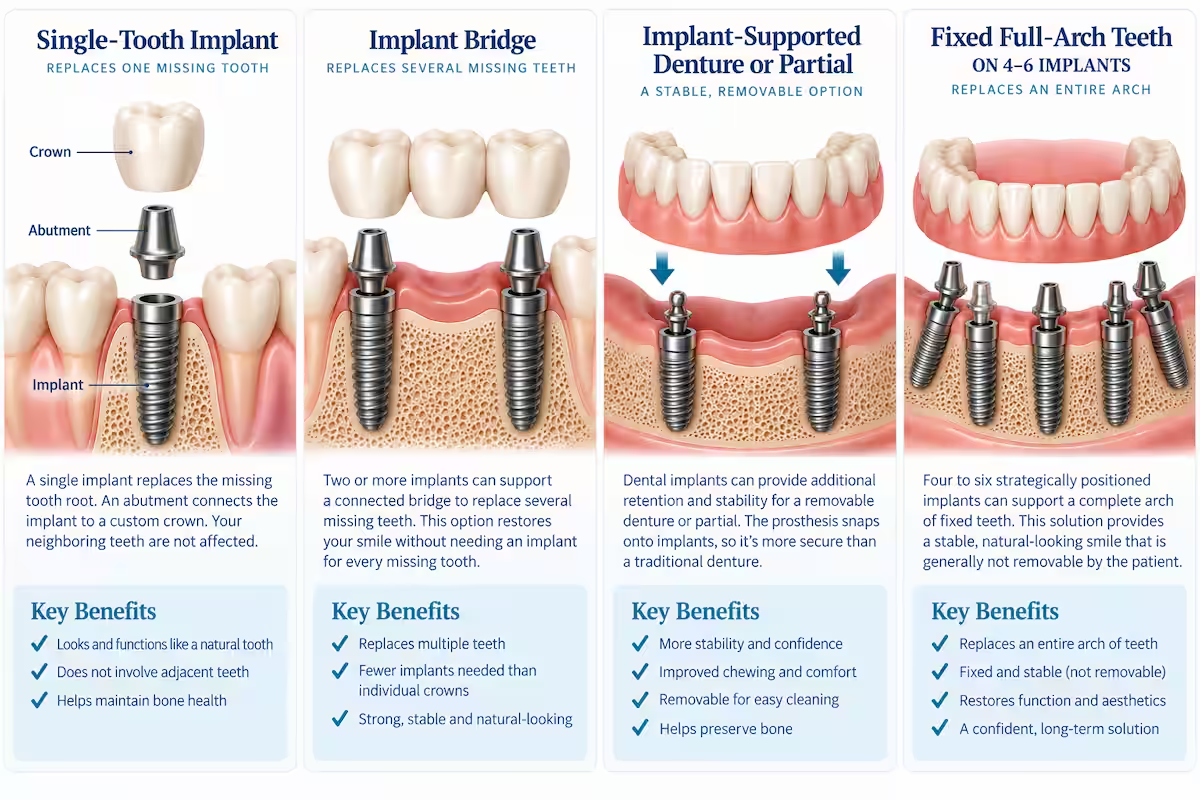
A single implant replaces one tooth with one post and one crown. It doesn't touch the teeth on either side, which is its main advantage over a bridge.
An implant bridge replaces three or four teeth in a row using two implants. You're not paying for an implant per tooth, which is why this is often more affordable than people expect.
An implant-supported denture uses two to four implants to hold a denture firmly in place. It snaps in and comes out for cleaning. For patients who hate how a conventional lower denture moves around, this is usually the change that matters most.
A fixed full arch uses four to six implants to carry a full set of teeth that stay in. You don't remove it. This is the most involved option and the most expensive.
What does "teeth in a day" actually mean?
It means a temporary set of teeth goes on the same day the implants are placed, so you don't leave without teeth. It does not mean treatment is finished that day.
The bone still has to integrate. The temporary is there so you can eat soft food and get on with your life while that happens. The permanent set comes months later, after everything has healed and settled.
Not everyone qualifies. It depends on how solid the implants feel at placement, which comes down to your bone quality. We can't promise it before the scan, and we'd rather tell you that up front than have you plan around it.
Who does the surgery and who makes the crown?
Both happen here. We have a periodontist in the practice, so the surgical placement and the restoration are handled under one roof by one team.
This is worth asking about wherever you go, because plenty of general offices refer the surgery to a specialist across town, then restore it themselves. That works fine, but it means two sets of appointments, two offices, two sets of paperwork, and occasionally two people with slightly different plans for your mouth. When something needs adjusting, it's also clearer who owns it.
Seaview has been treating families in Eatontown since 1981, and Dr. Polina Chernyak and Dr. Mariya Medlenov lead the practice today. You'll see the same team from scan to crown.
Are you a candidate?
Most adults with a missing or failing tooth are. The things we look at:
- Bone volume. Enough to anchor the post, or enough that grafting can get you there.
- Gum health. Active gum disease gets treated before an implant goes in. Implants can be lost to the same process that loosens natural teeth.
- Smoking. It meaningfully raises the risk of the implant failing to integrate. We'll talk about it honestly rather than pretend it doesn't matter.
- Diabetes and other conditions. Well-managed is usually fine. We'll ask about your medical history and any medications, particularly bone medications.
- Grinding. If you clench or grind, we may recommend a nightguard to protect the investment.
The American Dental Association's overview of implants is a reasonable neutral starting point if you want to read outside our site.
How patients pay for this
Almost nobody pays for a full arch out of pocket in one go. Here's what's available at our office.
CareCredit and Cherry both offer monthly payment plans, including interest-free periods for qualifying patients. Applications take a few minutes and you'll know before you commit to treatment.
FSA and HSA dollars apply to implants. If you have funds that expire at the end of the year, that's worth a conversation in November and December specifically.
Our Clerri in-house plan covers patients without dental insurance, with discounts on treatment for an annual fee. One caveat we state plainly: Clerri discounts can't be combined with Cherry or CareCredit. You pick one route.
Insurance, where you have it. We'll help you estimate benefits, but your plan decides coverage.
Full details sit on our financial options page.
Implant, bridge, or denture: which is right?
An implant is usually the best long-term answer for a single missing tooth, because it stands on its own and preserves the bone. It's also the slowest and the most expensive up front.
A bridge is faster and costs less. The trade-off is that it's anchored to the teeth on either side, which means reshaping two healthy teeth to carry it.
A partial or full denture is the most affordable and the quickest. It also moves, needs relining over time, and doesn't stop the bone from shrinking underneath.
There's no universally correct answer. Budget, timeline, how many teeth are involved and how much you care about never taking something out at night all legitimately change the choice. Our job is to lay out all three honestly, not to steer you toward the most expensive one.
What recovery is actually like
Most patients take over-the-counter pain relief for a day or two and go back to work the next day. Swelling peaks around day two or three. Soft food for about a week.
What's normal: mild soreness, some swelling, a little bruising.
What warrants a call: pain that's getting worse after day three rather than better, swelling that spreads, a fever, or an implant that feels loose. Call us at (732) 542-7770 rather than waiting it out.
Long term, an implant is cleaned like a natural tooth. Brush, floss or use a water flosser around it, and keep your checkups. The crown may need replacing at some point over the decades. The post itself, cared for, is meant to be permanent.
Frequently asked questions
Does getting an implant hurt?
The placement itself is done with local anesthetic and most patients report less discomfort than they expected, often less than an extraction. Soreness afterward is usually managed with ibuprofen. If you're anxious about it, ask about sedation options when you call.
How long do dental implants last?
Implants are designed to be a permanent replacement, and many last decades. The crown on top is the part more likely to need replacing eventually. Gum health and regular care are what keep the implant itself stable.
Will my insurance cover it?
It depends entirely on your plan. Some cover part of the crown, some exclude implants altogether, and some have annual maximums that a full case will exceed. Bring your details and we'll estimate what we can.
Can I get the implant the same day my tooth is removed?
Sometimes. Immediate placement is possible when there's no infection and enough solid bone around the socket. The scan at your consultation answers it. When it works, it saves months and often avoids a graft.
What if I've been missing the tooth for years?
You can still have an implant. You're more likely to need a graft first, which adds time and cost. It's still very much worth asking about.
Do you treat patients from outside Eatontown?
Yes. We see patients from Tinton Falls, Shrewsbury, Oceanport, West Long Branch, Little Silver and Long Branch regularly. We're on Route 35, a few minutes from Monmouth Mall.
Book a consultation
The honest next step is a scan and a conversation. Until we see the bone, any number either of us puts on your case is a guess.
At that visit you'll get a written estimate broken into its parts, a realistic timeline for your mouth specifically, and a straight answer about whether an implant is the right call or whether a bridge would serve you better for less.
Call (732) 542-7770 or request an appointment online. Seaview Dental, 286 Highway 35, Eatontown, NJ 07724. Monday and Wednesday 9 to 6, Tuesday and Thursday 9 to 5.